OUR WEBSITE | ABOUT US | SERVICES | THE TEAM | PROJECTS | TAX CREDITS | FEDERAL HTC | STATE HTC | CONTACT US

Tuesday, July 21, 2015

Historic Tax Credits Preserve Affordable Housing

Briarcliff Summit Apartments
Atlanta, GA
The term preservation means different things to different people. To colleagues in our firm, it can mean historic buildings, tax credits or advocacy. To many of our clients, it relates to keeping affordable apartments affordable at the end of their original financing or subsidy period. Many of these housing subsidy programs, like Section 8, have been around for decades and are managed by HUD. 

Not surprisingly, when the term of earlier subsidies end is aligned with the need for significant capital investment in the building. The owner often has to make a choice to preserve the existing affordable housing and reinvest, convert the property to market rate or owner occupied units, or to sell it to a third party. Fortunately, many current and new owners of these properties choose to preserve their affordability and they seek additional forms of financing. This often leads to incorporating state and federal historic tax credits (HTCs) as a component of their capital stack.

According to the Annual Report on the Economic Impact of the Federal Historic Tax Credit FY 2013, between 1978 and 2013 the historic tax credit program helped create over 135,000 units of affordable housing. HTC programs align well with housing preservation projects, as many of these units were created utilizing historic credits and the proposed work on the property will exceed the owner’s adjusted basis allowing for access to the historic credit again. In some cases, the buildings may have never had a historic designation when the units were developed as affordable, but are eligible for National Register listing today.  

A good example of the positive impact the historic credits can have is a recent MHA project, the Briarcliff Summit Apartments in Atlanta, Georgia. Originally constructed in 1924 as a residential hotel by Asa G. Candler Jr., the building was converted to affordable housing in the 1980s. It had fallen into significant disrepair when our client Evergreen Partners, who specialize in affordable housing and are active members of the Institute for Responsible Housing Preservation (IRHP), purchased it. Evergreen utilized a variety of sources for the project, including state and federal historic and low income housing tax credits (LIHTCs) as well financing from HUD.

“The physical needs and renovation challenges a developer encounters on a standard preservation project are always amplified when dealing with a historic structure,” says Evergreen Development Associate Nick Bouquet. “Briarcliff Summit had substantial deferred physical needs and was one of the most transformational projects Evergreen Partners has had the opportunity to participate in. The level of renovation needed to both revitalize the property and renew the building’s distinct historic features would have not been feasible without the availability of the historic tax credit resource”

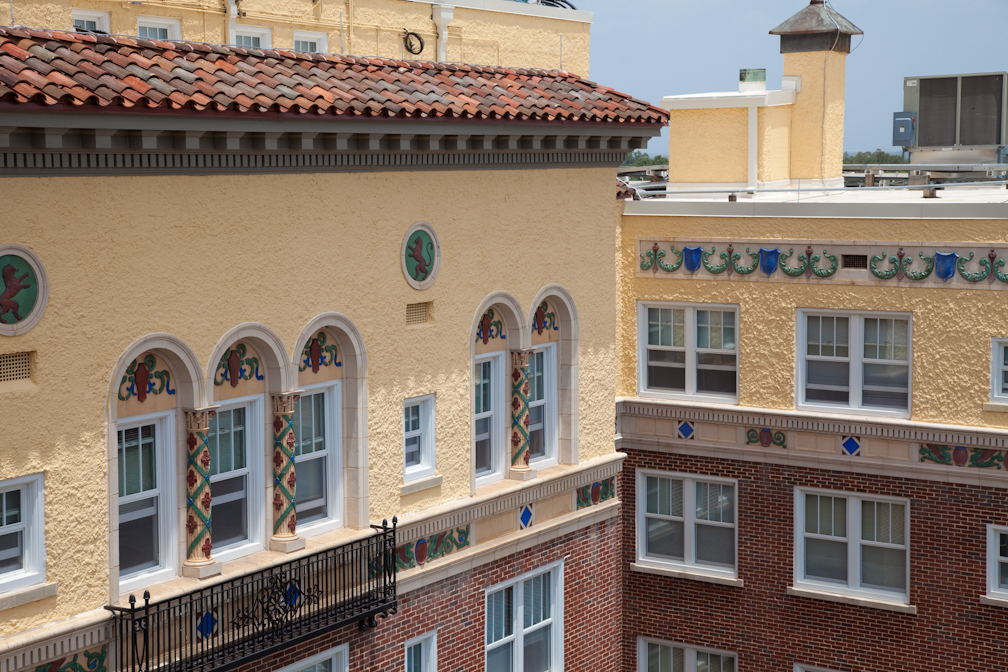
The capital stack for Briarcliff included state and federal LIHTCs. Combining these with HTCs provided additional funding sources and lead to many positive design aspects for the historic building. Project architects TAT (The Architectural Team) preserved the important decorative features originally designed by architect G. Lloyd Preacher including terracotta roof tiles, iron railings and floral glazed terracotta paneling. Perhaps most importantly for the preservation of the building, the incompatible 1970s era windows were replaced with new energy efficient units that match the windows shown in historic photographs.

Briarcliff Summit Apartments is an excellent example of how state and federal HTCs can be paired with a variety of housing subsidies to create a successful community preservation project. These projects preserve the physical fabric of the neighborhood by rehabilitating important historic resource, but also preserve the social fabric of community by providing high quality affordable housing for the residents who need it the most.


We recently outlined the increase in the Georgia state historic tax credit program in a previous blog. Learn more about these changes here.

Post by Richard Sidebottom |  Senior Associate, MHA Southeast

Friday, July 10, 2015

Historic Tax Credit Programs Make States Economically Competitive

Historic Lincoln School Apartments | Shawano, WI
Completed in October 2014, this former high school was converted to a 24-unit affordable housing apartment building. 

State tax credit programs come in many shapes and sizes, but one commonality is the economic impact they have of bringing investment to historic cities throughout a state. Many of these cities have historic resources related to a period of industry that certainly once shaped the community but now sit abandoned. Repurposing these buildings is a viable and important path to reinvestment. 

Another commonality is that state historic tax credit programs are often threatened from the beginning, as there is inevitably a debate between the dollars coming in as investment versus the dollars going out as tax credits.

Just such a debate has been ongoing in Wisconsin for the past year. Governor Walker proposed to cap the state tax credit program, which was just raised to an uncapped 20% program in January 2014, while the legislature has been working to preserve it in its current form. Since the program change, just 18 months ago, 25 projects have utilized the 20% credit resulting in an estimate of $480 million in construction spending and $88.7 million in annual operations according to a study done by Baker Tilly. 

As consultants on historic rehabilitation projects, we often see immediate results on these state programs once they are signed into law. “Our Midwest Office noticed a surge in the volume of Wisconsin rehabilitation projects in 2014 and 2015 due to the new state credit, including more small and medium sized projects which may not have been viable without the added bump from the increased state credit,” notes MHA partner and Midwest director, Allen Johnson. “We are also seeing projects being undertaken in small towns and cities where previously our work was wholly in Milwaukee.”

The good news is that the Wisconsin legislature prevailed and the program will not change in the coming year.

Meanwhile another scenario is playing out in North Carolina where several tax credit programs, mostly targeted at the state’s large resource pool of historic mills, have been allowed to sunset despite showing a strong economic impact since their creation in the late ‘90s. Myrick Howard, President of Preservation North Carolina, noted in his recent op-ed piece for the News & Observer that “the revival of downtown Durham, Raleigh, Winston-Salem, Asheville, Salisbury, Mount Airy, New Bern and Edenton, to name a few, hasn’t been coincidental. Nearly $2 billion have been spent by the private sector, stimulated by this statewide incentive.”


NODA Mills | Charlotte, NC

Wisconsin is fortunate to have preserved its credit and will certainly have a competitive advantage when it comes to attracting developers, especially from another state in its region, Michigan, which lost its state historic credit several years ago. Developers that are experienced in using the historic tax credit programs are expanding beyond their home states in order to take advantage of these benefits elsewhere. 

In a time of shrinking state budgets and less federal support, legislatures often look to “grow” their state budgets by eliminating historic tax credit programs despite several studies that show there is a positive return on investment from these programs. In addition to the construction dollars and jobs generated by rehabilitation projects, there is a long-term affect at the local level of taking a building that may have been completely off the tax roles and returning it to use, which generates increased real estate taxes that often funds schools or other local infrastructure. 

Hopefully North Carolina and other states will follow Wisconsin’s lead in supporting programs that can have a significant economic at the local level while knitting back together the architectural fabric that makes these cities and towns whole.


 Written by Albert Rex, Partner and Director of MHA Northeast

Wednesday, July 1, 2015

South Carolina Improves Historic Rehabilitation Tax Credit

The Westendorff | Charleston, SC

On June 9, South Carolina Governor Nikki Haley signed legislation that improves the state historic tax credit for rehabilitated income-producing properties and abandoned buildings. The most notable change is the new election for a 25 percent tax credit on rehabilitation costs for income-producing preservation projects.

Benefits of Historic Rehabilitation Tax Credit Increase

The 25 percent tax credit is an improvement for those projects that have rehabilitation costs up to $10 million. With a project cap of $1 million, rehabilitations over $10 million should seek the uncapped 10 percent tax credit.

One provision of the legislation that remains the same is that the credit must be taken in installments starting in the year in which the property is placed in service. However, the term for those installments has been reduced from five years to three years, which is good news for investors.

The final adjustment made to this tax credit legislation enables an ownership group to assign the tax credit to another entity through a pass-through tenant structure.

Changes to Abandoned Building Rehabilitation Tax Credit

South Carolina’s Abandoned Building Tax Credit also received changes in the 2015 round of amendments that includes a new definition for a ‘state-owned abandoned building’, the inclusion of insurance premium taxes as one of the taxes against which a credit can be claimed, the reduction of the credit term from five to three years, and the removal of a limitation related to the amount a taxpayer’s tax liability may be reduced.  An additional section was added to outline the manner in which a taxpayer can receive certification of an abandoned building site.

These revisions, that were effective immediately on the governor’s signing, signify an acknowledgement by state lawmakers that the rehabilitation of historic buildings is a powerful economic development tool in historic communities across the Palmetto state.

Written by Richard Sidebottom, Senior Associate

MHA associates are well versed in state programs across the country. Contact us if you have questions about these South Carolina programs or other historic rehabilitation tax credits.


Wednesday, June 24, 2015

Iconic Chicago Buildings Are Now the Hippest Hotels in Town

Credit: Chicago Athletic Association


In Chicago, everyone is invited to be part of the club.

The first half of 2015 has seen a rash of new boutique hotels open in iconic Chicago buildings that were purpose-built to be exclusive to members and account holders only. Today, you don’t have to be a member to book a room at the Chicago Athletic Club Hotel, the Hampton Inn in the Chicago Motor Club, or Virgin’s first hotel in the Old Dearborn Bank Building.

Accommodating the 21st Century Traveler in 19th and Early-20th Century Buildings

These historic building conversions are part of an international trend towards boutique hotels. As the industry heats up with the economic growth experienced over the last few years, hoteliers are focusing on a new strategy to accommodate a new type of traveler. These consumers prefer authenticity to consistency. They want to Instagram photos of architectural detail and eat among locals in hip and trendy restaurants. And what better marketing tool for hotels than historic buildings that provide a sense of place to their guest?

Chicago hotels are also benefiting from growth in the manufacturing and high-tech sectors and the business travelers attached to them. According to the “World Business Chicago” 2014 Annual Report, the last year saw 21,700 new jobs bolstered by companies like ADM, Braintree, Wanda Group and Yelp, and included $6.8 million in investment.

Tourism is, of course, a major factor in the success of the accommodations sector. According to some estimates, 60 percent of hotel developments have taken place in the north Loop/Michigan Avenue, where millions of tourists visit this area each year drawn by its proximity to Chicago’s Gold Coast and Magnificent Mile shopping area.

Financial Incentives for Hotel Conversions

According to a March 2014 New York Times article, the National Park Service estimates that 4.5 percent of all federal historic tax credits (HTCS) are used for hotel conversions in historic buildings. In Chicago, this 20 percent tax credit can be coupled with the Class “L” Property Tax Incentive that reduces assessment levels for 12 years. (In many other states, the federal HTC can be paired with state HTC programs.)

These financial incentives also provide inherent benefits to the community at-large. In most cases, historic tax credits make these hotel projects feasible for the developer and encourage sensitive preservation of historic landmarks in cities across the country. Hotels, in particular, also provide a mix of economic benefits that include generating substantial sales, room and property taxes and creating direct and indirect jobs.

The Value of Historic Consulting

MacRostie Historic Advisors (MHA) provided historic consulting to many of the most talked-about Chicago hotel conversions in 2015. Among the services provided were:
  • historic research that helped to provide the project teams with photos and documents that allowed for sensitive restorations of architectural detail,
  • federal historic rehabilitation certifications for these hotels that allows for the projects to obtain the federal HTC,
  • and Class “L” eligibility applications that allows for the reduction in property assessment values.

Our MHA Midwest team, based in Chicago, worked closely with our partners to ensure the success of these projects that relied heavily on historic tax credits. 

12 S. Michigan Ave.

Credit: Nick Fochtman / Curbed Chicago / Chicago Athletic Association Hotel

This Venetian-Gothic 1893 Henry Ives Cobb creation was home to a private athletic club for men (and in the late 20th century, women) of the Chicago elite until 2007. AJ Capital Partners and Commune Hotels & Resorts took ownership in 2012 and transformed the intricately detailed structure into a 241-room hotel that opened in May. The rehabilitation restored bas-relief woodcarving elements, 19th century stained glass, ornate marble staircases and the terra cotta façade.


203 N. Wabash Ave.

Credit: Nick Fochtman / Curbed Chicago / Virgin Hotel
Completed in 1928, architects Rapp and Rapp designed the neoclassical structure to be an office building for the Old Dearborn Bank. Despite the unfortunate timing of opening just before the Great Depression, the 27-story building has survived the greater part of a century and was acquired in 2011 Virgin Hotels (Virgin Group) as the company’s first hotel venture. This contemporary 250-room hotel retains the 1920s oak cigar bar, brass elevator doors in the lobby, and the original tiled ceiling. The crown jewel in the project is undoubtedly the reinstatement of the two-story lobby, the original banking hall that had been divided into two floors in the 1950s to accommodate more office space. Following rehabilitation guidelines that are intrinsic to the historic tax credit process, Virgin was able to creatively weave together modern touches with historic details to create a truly spectacular experience.


68 E. Wacker Place

Credit: chicagoarchitecture.org

Before the days of AAA, the Chicago Motor Club was a haven for early motorists. This 1928 Art Deco gem was designed by Holabird & Root, and the 17-story building now houses 143 rooms. A great deal of attention was paid the historic aspects of the building, including details in the three-story lobby such as the original John Warner Norton 29 foot wide road map. A 1928 Model A was even installed on a mezzanine as a nod to the year the building opened. Rehabilitation included careful restoration and repair of exterior terra cotta, stone, and limestone. The architecture team at Hartshorne Plunkard created an exquisite LEED certified design throughout that preserved the historic features of the building.


It’s a decidedly good time to be a traveler in Chicago. It is more about the destination than the journey for once, and that is because developers see the value in historic structures, made even more valuable by the generous incentives of historic rehabilitation tax credits.

Monday, June 22, 2015

Four Outstanding Chicago Rehabs Receive Awards


We are pleased to announce that four of our projects from the MHA Midwest office were selected as recipients of prestigious Chicago preservation awards last week. All of these projects utilized the federal historic tax credit as well as city-offered programs to make their rehabilitations a reality.

Without further ado, the winners are...


___________________________________________________________________

Hampton Inn at the Chicago Motor Club
Chicago Art Deco Society | 2015 Joseph Loundy Preservation Award


On Thursday, June 18, we, along with other members of the project team, including owners MB Real Estate, were awarded Chicago Art Deco Society's first-ever Joseph Loundy Preservation Award. Named for the former president of the Society, this award commends the restoration work undertaken to preserve one of the finest examples of Art Deco architecture in Chicago. 

The Chicago Motor Club was built in 1928 at 68 E. Wacker Place, and was an early automobile clubhouse for motorists in the Windy City who could find road maps and travel maps in this pre-AAA era. Standing 15 stories tall, notable exterior features of the building include it's slender footprint, limestone, terra-cotta bas relief panels, a steel frame awning with glass panels that allow you to see enjoy the fast moving lines of the automobile temple when standing at the base of the building, and the iconic Chicago Motor Club circular emblem of the letter "C" surrounding a red star. Inside, the lobby features an original 29 foot, two-story United States road map mural created by artist John Warner Norton, more bas relief detail, green and black terrazzo floors, and shimmering silver accents throughout.

The federal historic rehabilitation tax credit and the Chicago Class L Property Tax Reduction Incentive were used for this project.

___________________________________________________________________

The Old Dearborn Bank Building / Virgin Hotel
Commission of Chicago Landmarks | 2015 Chicago Landmark Award for Preservation Excellence


The Chicago Landmark Award for Preservation Excellence is given to individual Chicago Landmarks or to buildings within Chicago Landmark Districts. The Old Dearborn Bank Building, now the first Virgin Hotel, is a distinguished recipient of this year's award class. 

The John Buck Company and Virgin Hotels North America led a spectacular rehabilitation and adaptive reuse effort to convert this 1920s bank and office building into a modern hotel. Modern as it may be, the historic touches that were restored are the real show-stoppers. Terra cotta exterior features were repaired while the lobby harkens back to the original banking hall splendor that includes restored entry frame ornamentation, marble walls, terrazzo flooring, an original cigar bar and a mail chute in the first floor lobby. For all public spaces, coffered ornate ceilings and ornamental elevator elements were restored. In addition, sensitive treatments for new sprinkler and mechanical systems and the installation of a "green" roof exemplified how modern techniques fit in with preservation projects.

The federal historic rehabilitation tax credit and the Chicago Class L Property Tax Reduction Incentive were used for this project.

___________________________________________________________________

Steger Building
Commission of Chicago Landmarks | 2015 Chicago Landmark Award for Preservation Excellence


Another winner of a Chicago Landmark Award for Preservation Excellence is the Steger Building on East Jackson Boulevard, owned by CA Student Living. This 1909 Neoclassical Chicago skyscraper was originally built as the headquarters for Steger & Sons Piano Manufacturing Company and was part of the city's historic "Music Row." 

Under the new ownerships, the building was designated as a Chicago Landmark and has been adapted to house college students and also has retail space, but still retains many of its defining Classical features. The three-story base has intricate terra cotta details while the lobby is ornately embellished with decorative plaster and the walls feature terra cotta garlands, swags, medallions, rosettes, and foliated bands.

The federal historic rehabilitation tax credit and the Chicago permit fee waiver program were used for this project.

___________________________________________________________________

The Inland Steel Building
Commission of Chicago Landmarks | 2015 Chicago Landmark Award for Preservation Excellence


The only mid-century building on our list of award winners, the Inland Steel Building was built in 1958 with an innovative column-free high-rise design. It was the first skyscraper built in the Chicago Loop after the Great Depression.

Capital Properties received this award for the outstanding rehabilitation they undertook, primarily on the interior spaces and most notably the historic lobby. Energy efficiency upgrades and a new vegetative "green" roof also contributed to the success of the rehabilitation that led to a Class A rating for the building, an increase in tenant capacity, and energy reductions of about 65% on a typical floor.

The federal historic rehabilitation tax credit and the Chicago Class L Property Tax Reduction Incentive were used for this project.